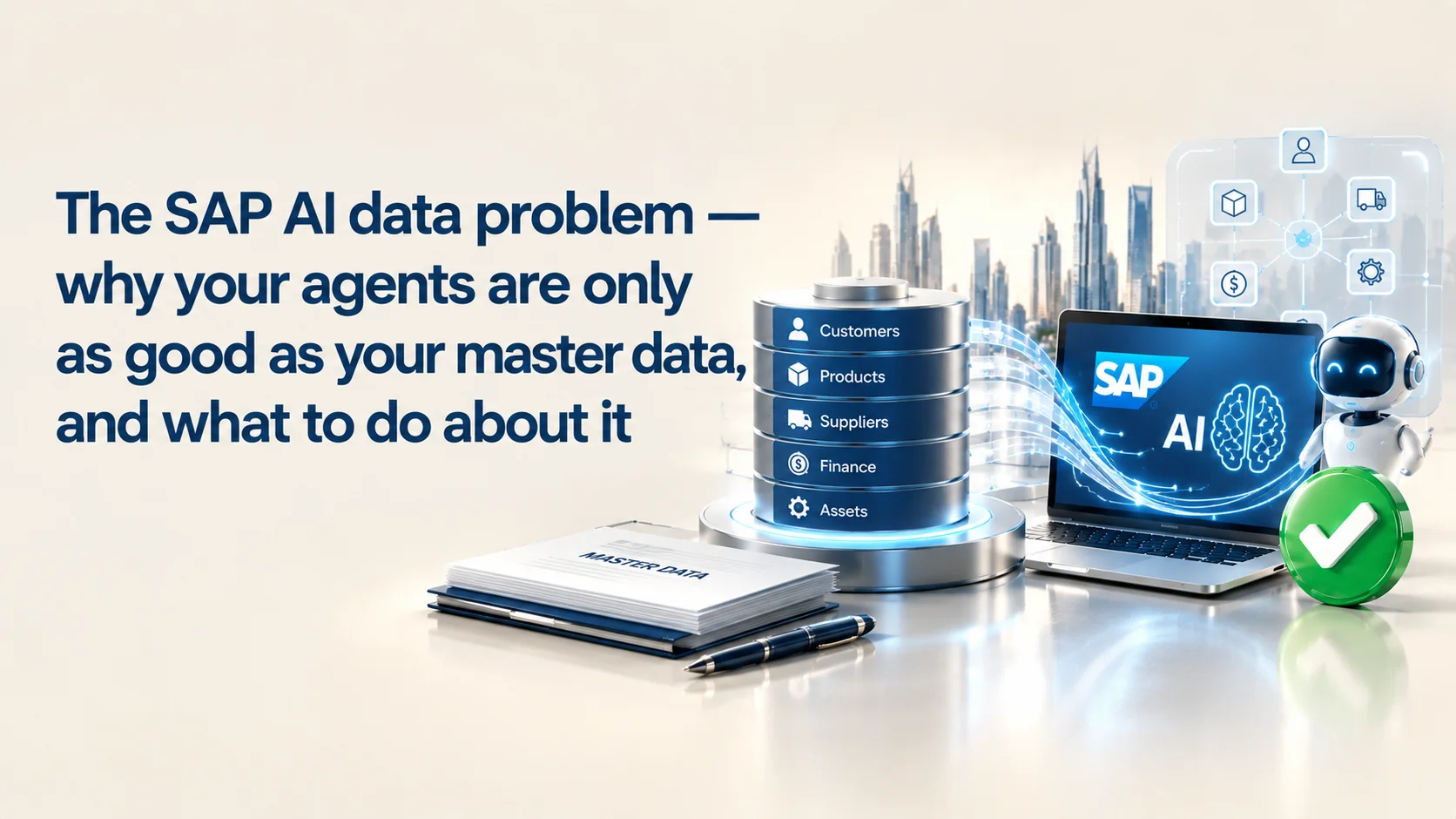
The SAP AI data problem — why your agents are only as good as your master data, and what to do about it
01SAP’s most honest sentence about AI
The most useful sentence in SAP’s 2026 AI messaging is not about agents at all. It is this, from the President of SAP EMEA: “AI is only as reliable as the data and processes it operates on. Fragmented master data, siloed systems, and over-customized ERP landscapes introduce unpredictability at the worst possible moment.” SAP’s newsroom repeats the diagnosis from another angle: AI “cannot reach its full potential when data is fragmented across business units, platforms and domains without connection or context”. Microsoft’s SAP guidance corroborates the premise from outside the SAP estate: enterprise SAP data is frequently “siloed and isn’t integrated with other data sources inside or outside of the organization”.
Every agent demo assumes this problem away. Your landscape does not get to. An agent asked to resolve a supplier dispute will retrieve a supplier record — and if the same supplier exists three times with two bank accounts and an outdated address, the agent’s confident answer inherits all of that. The unpredictability SAP describes is not the model misbehaving; it is the model faithfully reflecting the master data underneath it.
02Where SAP is heading: the golden record
SAP’s answer at the strategic level is visible in its March 2026 move to acquire Reltio, whose AI-based entity resolution “identifies and merges related records from different formats and applications into one reliable ‘golden record’ system of context”. The promise attached is explicitly forward-looking: customers “will be able to rely on trusted, high-quality data across SAP and non-SAP sources that Joule and Joule Agents use” — future tense, tied to a pending acquisition. Plan for it; do not architect your 2026 data program around it.
Plan for it; do not architect your 2026 data program around it.
03What is standard today: the Business Partner model
The unglamorous foundation is already in your S/4HANA system. The Business Partner is the single point of entry to create, edit and display master data for business partners, customers, and vendors: creating a BP posts all required fields in the customer/vendor records, and updating the BP updates the corresponding customer/vendor at the same time. One leading object, synchronized records, no drift between the sales view and the finance view of the same counterparty. If your migration treated BP/CVI as a technical checkbox rather than a data-quality gate, that debt is now an AI-reliability problem.
04Clean core is a data discipline, not just a code discipline
SAP’s clean-core definition is broader than most teams quote. “Clean” means “a system that is up-to-date, transparent, unmodified, consistent, efficient, and cloud compliant” — and “core” explicitly spans “extensibility, process, data, integration, and operation”. Data is a named dimension, with a named bar: complete, correct and compliant data. Read alongside the EMEA president’s warning about “over-customized ERP landscapes”, the implication is direct: clean core is a data-quality prerequisite for reliable agents, not merely an upgrade-stability play for upgrade-stable customer extensions.
05Governance that agents can actually use: MDG and the harmonized layer
Master Data Governance is live and increasingly AI-touched: SAP’s Q4 2025 release highlights list as generally available the ability to interact with Master Data Governance functions using natural language, “allowing for seamless search, display, submission of new business partners”. Above the single system, SAP defines the harmonized layer it wants agents grounded in: a business data fabric — an “integrated, semantically rich data layer over underlying data landscapes to provide seamless and scalable access to data without duplication” (SAP’s foundational 2023 definition) — now carried by SAP Business Data Cloud, which harmonizes “data from organizations’ most mission-critical applications” as the trusted data foundation for “more impactful decisions and… reliable AI”.
The architecture that consumes all this is explicit about the dependency: SAP’s North Star agent architecture has agents find the correct data “through semantic grounding in SAP Knowledge Graph, and act within governed boundaries”, with SAP positioning governed data and process knowledge compounding “into a new kind of enterprise intelligence”, and models grounding responses “in verified enterprise data, providing the accuracy and dependability that critical business operations require”. Semantic grounding cannot resolve what the master data leaves ambiguous. One further status note from SAP’s own release highlights: the AI portfolio is explicitly a mix — features ship as general availability, beta release, or SAP Early Adopter Care — so check the label on any data-layer capability in your plan.
06What to do about it — a sequencing view
This sequence is IOTEK’s delivery method, stated as such (the individual capabilities above are SAP-sourced; the ordering is our practice):
- Measure before you model. Profile duplicates, incomplete records and conflicting attributes in the domains your first agents will touch — usually Business Partner and product. This becomes the baseline your agent evals refer back to.
- Fix the leading objects first. BP/CVI consistency and ownership rules for customer/vendor data precede any agent that reads them.
- Put governance where data is born. MDG-style controls at the point of creation beat cleansing campaigns after the fact; a natural-language interface to governance lowers the excuse threshold for the business to use it.
- Harmonize only what agents will consume. Scope the data-fabric/BDC layer to the processes on your agent roadmap rather than boiling the estate.
- Make data readiness a gate in every agent business case. If a use case’s underlying master data fails the profile, the remediation belongs inside that business case — not discovered at hypercare.
Measure before you model
Profile duplicates, incomplete records and conflicting attributes in the domains your first agents will touch — usually Business Partner and product. This becomes the baseline your agent evals refer back to.
Fix the leading objects first
BP/CVI consistency and ownership rules for customer/vendor data precede any agent that reads them.
Put governance where data is born
MDG-style controls at the point of creation beat cleansing campaigns after the fact; a natural-language interface to governance lowers the excuse threshold for the business to use it.
Harmonize only what agents will consume
Scope the data-fabric/BDC layer to the processes on your agent roadmap rather than boiling the estate.
Make data readiness a gate in every agent business case
If a use case’s underlying master data fails the profile, the remediation belongs inside that business case — not discovered at hypercare.
The uncomfortable truth in SAP’s own words: the ceiling on your agents is set by your master data. Fund the master data program as part of the AI program — because when data quality work is done first, agents ship faster, behave predictably, and pass audit. In that order lies the difference between an AI strategy and an AI incident.
Sources
Find out what your agents will actually inherit.
Thirty minutes, one process, an honest profile of duplicates, incomplete records, and conflicting attributes in the domains your first agents will touch.
Book a 30-minute SAP AI readiness call