
Agentic AI for SAP Finance — automating the period-close, exception-handling and reconciliation work that costs controllers weeks every month
Start with the table, not the agent
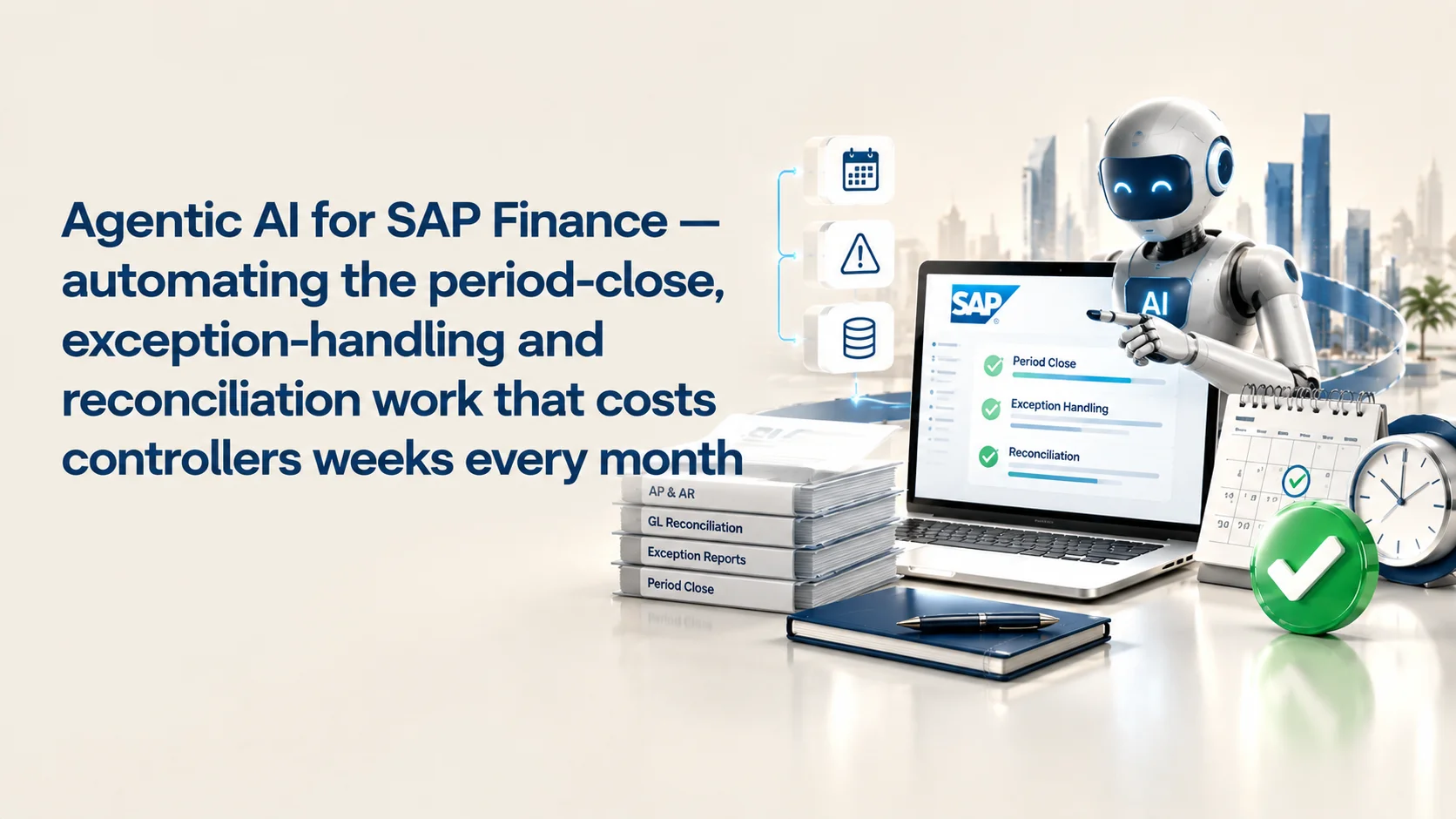
Agentic AI for SAP Finance — Period-Close
Any honest discussion of AI in SAP finance starts with a piece of architecture that predates the hype: the Universal Journal. In S/4HANA, actual financial accounting and controlling data is recorded in one single table — ACDOCA — which acts as the definitive single source of truth for financial data, integrating General Ledger, Asset Accounting, Controlling, Profitability Analysis and the Material Ledger. The consequence SAP states plainly: since all financial data is based on the same line items, “no reconciliation between financial accounting and controlling is necessary”.
Start with the table, not the agent
That matters for agents in two ways. First, a whole class of reconciliation your ECC-era close absorbed simply does not exist on a well-built S/4HANA system — some of the “AI will fix your reconciliations” pitch is solved by data architecture, not intelligence. Second, whatever agents you deploy inherit ACDOCA as their ground truth: one consistent set of line items to reason over, rather than parallel ledgers to arbitrate between.
Orchestrating the close: the deterministic backbone
Period-close orchestration in the SAP stack today runs through SAP Advanced Financial Closing — an established cloud solution used to plan, supervise and evaluate the financial close process in a way that ensures compliance and enhances overall efficiency, coordinating period-end and year-end closing across business entities. This is the deterministic backbone: task lists, dependencies, sign-offs. The agentic question is what gets layered onto it.
The finance agent roster — with the availability label each one actually carries
Read SAP’s finance-agent announcements with a highlighter for tense and status, because the portfolio spans three distinct states:
- Announced / roadmap: the cash collection Joule agent, previewed at TechEd 2024, was announced in February 2025 with “planned first quarter availability”; SAP said it “will analyze disputes and work across finance, customer service, and operations to validate details and recommend resolutions”. Future tense at source — we found no fetched SAP page confirming it later reached GA, so treat it as planned until verified.
- Explicit beta: the Dispute Resolution Agent automatically scans invoices and contracts to identify errors, inconsistencies, and discrepancies — and SAP’s own learning page carries the caveat verbatim: “The Joule agent shown is a BETA release and may not be generally available. Features, behavior, and availability are subject to change.”
- Announced at Sapphire 2026: SAP says the new Autonomous Close Assistant “can compress the financial close process from weeks to days by automating journal entries, reconciliation and error resolution”. “Weeks to days” is SAP’s own qualitative claim, not an independently verified metric — and no fetchable SAP page attaches a GA date.
- Named, detail pending: SAP’s Q3 2025 release highlights position the Cash Management Agent and International Trade Classification Agent as finance agents — the closest SAP-announced capability to a bank-reconciliation agent, named at announcement level without functional depth in the fetched sources.
You may notice what is missing from that list: hard percentages. Time-savings figures for finance reconciliation circulate in trade coverage, but none appears verbatim on a fetchable SAP primary page — so none appears here.
Grounding: why the agents cite your data, not the internet
SAP’s stated approach is that SAP Business Data Cloud “equips Joule agents with a single trusted data layer that breaks down data silos, unifying data across SAP and non-SAP sources”, with Joule Agents reasoning “over real, semantically rich enterprise data” and agents leveraging a company’s internal SAP business knowledge to provide accurate answers. For a controller, the practical reading is: agent output quality is a function of your master data, your ACDOCA hygiene and your document quality. The agent does not transcend the landscape it is grounded in.
The line that keeps auditors comfortable
Here is the design principle we hold at IOTEK — our editorial framing, though SAP’s governance language points the same way. Keep the postings deterministic and let agents work the judgment around them: flagging the exception, assembling the evidence, drafting the resolution, routing the escalation — with a human approving anything that commits to the ledger. SAP frames it as anchoring AI agents “in the business processes, data and governance so they can deliver accurate, compliant and secure outcomes”, and states that corporate governance — “including approval flows, compliance processes, identity management, and the ability to audit decision-making” — must carry into how AI is deployed. Your close gets faster because exceptions surface with evidence attached, not because a model writes journal entries unsupervised.
What a finance leader should do this quarter
Three moves, in order. Confirm your ACDOCA foundation — if you are still on ECC or a compromised migration, the data architecture win comes first. Pilot where the status is firm: Advanced Financial Closing for close orchestration is established product; agent pilots belong in exception-handling flows where a human already reviews the outcome. And put an availability column in every business case: GA, beta or announced — because in this portfolio all three states are live simultaneously, and budgeting against a roadmap slide is how finance transformation programs end up explaining themselves to the audit committee.
The period-close will get shorter — SAP’s direction is clear and the architecture is sound. But the wins come in layers: ACDOCA removed reconciliation work by design, close orchestration made the rest visible, and agents are now taking the exceptions. Deploy them in that order, label every capability by its real status, and keep the postings deterministic with a human on the gate.
Sources
Talk to us about this engagement.
Thirty minutes, one process, an honest read. No deck, no obligation.