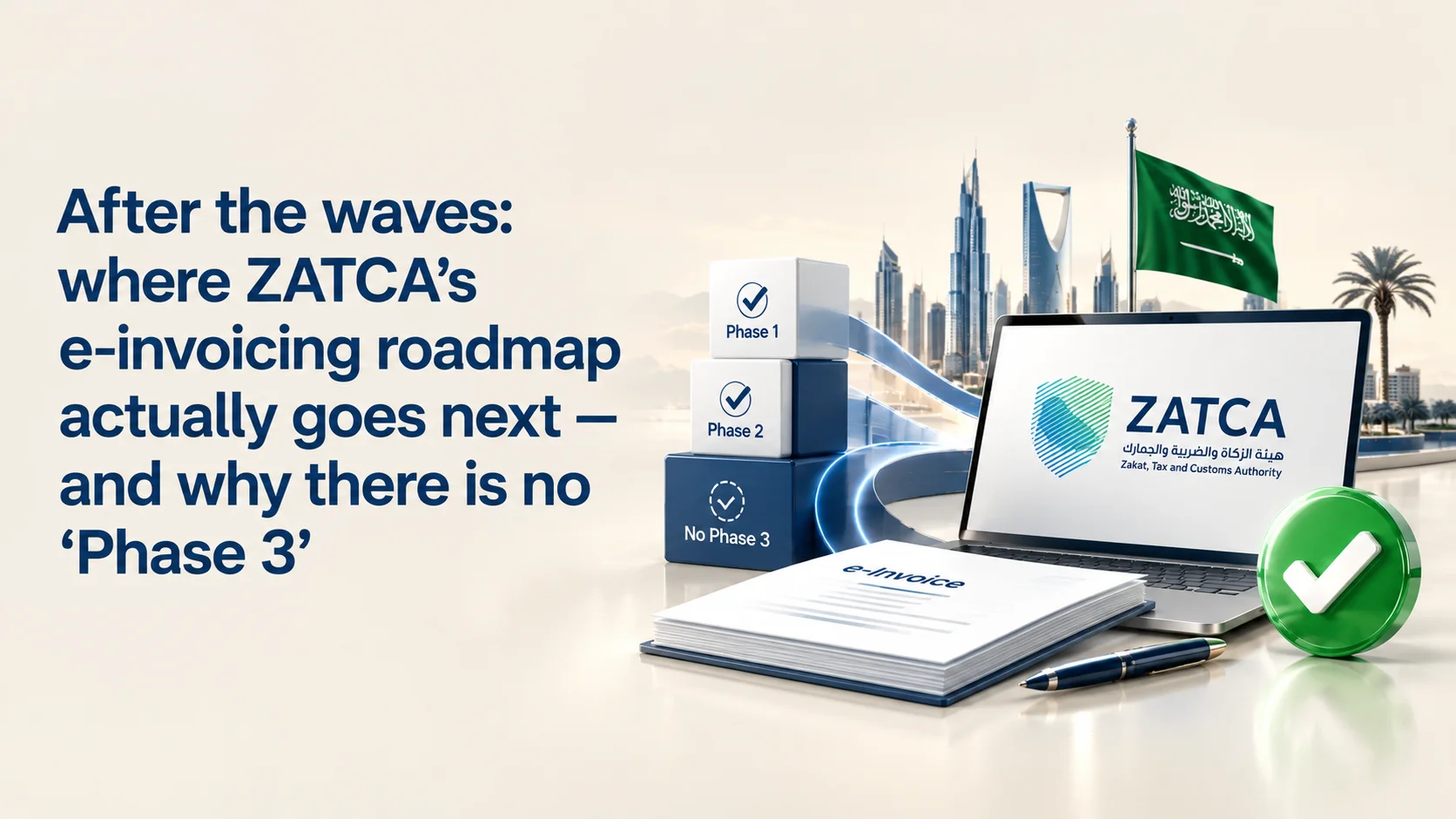
After the waves: where ZATCA’s e-invoicing roadmap actually goes next — and why there is no ‘Phase 3’
01The question every KSA tax team is asking
With Phase 2 integration waves now reaching businesses with a few hundred thousand riyals of VAT-relevant revenue, the natural question is: what comes after the waves? Vendors and conference decks are happy to speculate about a “Phase 3.” The honest answer, from ZATCA’s own published material, is simpler and more useful: there is no Phase 3 — announced or otherwise — and the roadmap that actually exists is demanding enough on its own.
02First, the record: two phases, not three
ZATCA structures the e-invoicing mandate in exactly two phases. Phase 1, the Generation Phase, has been mandatory since 4 December 2021 for all resident taxpayers: invoices and notes must be generated and stored electronically. Phase 2, the Integration Phase, commenced 1 January 2023 and is rolled out in waves by targeted taxpayer group: on top of generation, taxpayers must meet additional technical requirements and integrate their e-invoicing solutions with ZATCA’s Fatoora platform, transmitting e-invoices and e-notes to the authority.
That is the whole officially announced structure. Independent compliance trackers reviewing the mandate make the same point explicitly: no Phase 3 is mentioned anywhere. Any statement about what a “Phase 3” will require is speculation, and this article will not make one.
03The real roadmap: thresholds falling, wave after wave
What ZATCA has actually been doing — consistently, for three years — is extending Phase 2 to progressively smaller taxpayers by descending VAT-revenue threshold. Three sourced points on that curve:
- Wave 11: taxpayers with taxable turnover above SAR 15 million (2022 or 2023), integrating between 1 November 2024 and 31 January 2025 (as reported by EY).
- Wave 23: taxpayers with turnover exceeding SAR 750,000 (2022, 2023 or 2024), with an integration window of 1 January to 31 March 2026 (as reported by EY).
- Wave 24: announced 26 September 2025, covering taxpayers with VAT-subject revenue exceeding SAR 375,000 (2022, 2023 or 2024), integrating with Fatoora no later than 30 June 2026 (as reported by EY; re-confirm against ZATCA’s own announcement before relying on the exact figures).
Taxpayers with taxable turnover above SAR 15 million (2022 or 2023), integrating between 1 November 2024 and 31 January 2025 (as reported by EY).
Taxpayers with turnover exceeding SAR 750,000 (2022, 2023 or 2024), with an integration window of 1 January to 31 March 2026 (as reported by EY).
Announced 26 September 2025, covering taxpayers with VAT-subject revenue exceeding SAR 375,000 (2022, 2023 or 2024), integrating with Fatoora no later than 30 June 2026 (as reported by EY; re-confirm against ZATCA’s own announcement before relying on the exact figures).
From SAR 15 million down to SAR 375,000: the Integration Phase is reaching down towards the smallest VAT-registered businesses in the Kingdom. ZATCA has not said any wave is the last. The mechanism is predictable even when the announcements are not: ZATCA notifies each targeted group at least six months before its integration date. Six months is your contractual runway; treat it as such.
ZATCA notifies each targeted group at least six months before its integration date — that is your contractual runway, not a suggestion.
To be precise about what we can and cannot say about 2026–2027: the continued wave rollout is the sourced trajectory. Anything beyond it — new document types, new mandates, expansion of scope — is projection, and we found no official announcement of any such expansion at the time of writing. If a vendor tells you otherwise, ask for the ZATCA source.
04The models that will govern more and more of your invoices
As waves land, more of the Kingdom’s invoice volume moves under Phase 2’s two processing models. E-invoicing in ZATCA’s definition converts paper invoicing into a structured electronic exchange between buyer and seller through an integrated solution — and Phase 2 puts the regulator inside that exchange. Standard tax invoices (B2B/B2G) follow the clearance model: submitted to the Fatoora platform, validated and cryptographically stamped by ZATCA before delivery to the buyer. Simplified tax invoices (B2C) follow the reporting model: issued to the customer with a QR code and cryptographic stamp, then reported to Fatoora within 24 hours. Both invoice categories carry cryptographic stamps and QR codes.
The systems implication is unchanged from wave one, but it now applies to your subsidiaries, joint ventures and smaller group entities too: for standard invoices, a document that fails validation is not a report you correct later — it is an invoice your customer never receives.
As waves land, more of the Kingdom’s invoice volume moves under Phase 2’s two processing models. E-invoicing in ZATCA’s definition converts paper invoicing into a structured electronic exchange between buyer and seller through an integrated solution — and Phase 2 puts the regulator inside that exchange.
Standard tax invoices (B2B/B2G)
Clearance model: submitted to the Fatoora platform, validated and cryptographically stamped by ZATCA before delivery to the buyer.
Simplified tax invoices (B2C)
Reporting model: issued to the customer with a QR code and cryptographic stamp, then reported to Fatoora within 24 hours.
Both invoice categories carry cryptographic stamps and QR codes. The systems implication is unchanged from wave one, but it now applies to your subsidiaries, joint ventures and smaller group entities too: for standard invoices, a document that fails validation is not a report you correct later — it is an invoice your customer never receives.
05The SAP anchor: Document and Reporting Compliance
For SAP-run businesses, the solution anchor for these mandates is SAP Document and Reporting Compliance (DRC) — in SAP’s words, an end-to-end solution to create, process, and monitor transactional documents and periodic regulatory reports across countries or regions, addressing regulatory change in compliance reporting, e-invoicing and document exchange. It is one solution spanning multiple jurisdictions’ mandates, and SAP’s own DRC country content explicitly includes Saudi Arabia’s e-invoicing localization. (KSA-specific capability detail — exact formats, editions, licensing — should be verified against SAP’s product documentation for your landscape; we deliberately state DRC at the level SAP’s public material supports.)
The strategic reason DRC matters for the roadmap question: a wave-by-wave regime rewards a standardized compliance layer. Every future wave that pulls another group entity into scope, and every technical update ZATCA issues, lands either as configuration in a maintained product layer — or as another change request against custom code. Over a multi-year rollout, that difference compounds.
06What to actually do in 2026–2027
Map your group’s KSA entities against the announced waves and their VAT-relevant revenues — including the small ones you have been ignoring. Watch ZATCA’s announcements, not commentary; the six-month notice is the only timeline that binds. Consolidate group entities onto one compliance architecture rather than letting each subsidiary solve its own wave. And when planning beyond the announced waves, plan for continuity — more waves, same models — not for an imagined Phase 3.
Four actions, drawn directly from the pattern above:
Map your group’s KSA entities against the announced waves and their VAT-relevant revenues — including the small ones you have been ignoring.
Watch ZATCA’s announcements, not commentary; the six-month notice is the only timeline that binds.
Consolidate group entities onto one compliance architecture rather than letting each subsidiary solve its own wave.
When planning beyond the announced waves, plan for continuity — more waves, same models — not for an imagined Phase 3.
The most useful thing to know about ZATCA’s roadmap is what is not on it. There is no Phase 3; there is a regulator methodically extending a working system to every VAT-registered business in the Kingdom. Plan for the pattern, not the rumor.
Sources
| # | URL | Publisher |
|---|---|---|
| 1 | https://zatca.gov.sa/en/E-Invoicing/Introduction/Pages/Roll-out-phases.aspx | ZATCA (official) |
| 2 | https://zatca.gov.sa/en/E-Invoicing/Pages/default.aspx | ZATCA (official) |
| 3 | https://www.ey.com/en_gl/technical/tax-alerts/saudi-arabia-announces-24th-wave-of-phase-2-e-invoicing-integration | EY Global (secondary) |
| 4 | https://www.ey.com/en_gl/technical/tax-alerts/saudi-arabia-announces-23rd-wave-of-phase-2-e-invoicing-integration | EY Global (secondary) |
| 5 | https://www.ey.com/en_gl/technical/tax-alerts/saudi-arabia-announces-11th-wave-of-phase-2-e-invoicing-integrat | EY Global (secondary) |
| 6 | https://www.theinvoicinghub.com/zatca-e-invoicing-mandate-in-saudi-arabia-the-complete-guide/ | The Invoicing Hub (specialist, Tier-C) |
| 7 | https://www.theinvoicinghub.com/einvoicing-compliance-saudi-arabia/ | The Invoicing Hub (specialist, Tier-C) |
| 8 | https://pages.community.sap.com/topics/document-reporting-compliance | SAP (official) |
| 9 | https://zatca.gov.sa/en/Pages/news_1426.aspx (Wave 24 primary) | ZATCA (official) |
Get ahead of the next wave, not the rumor.
Thirty minutes, one process, an honest map of your group’s KSA entities against the announced waves and a standardized DRC compliance architecture.
Book a 30-minute SAP AI readiness call