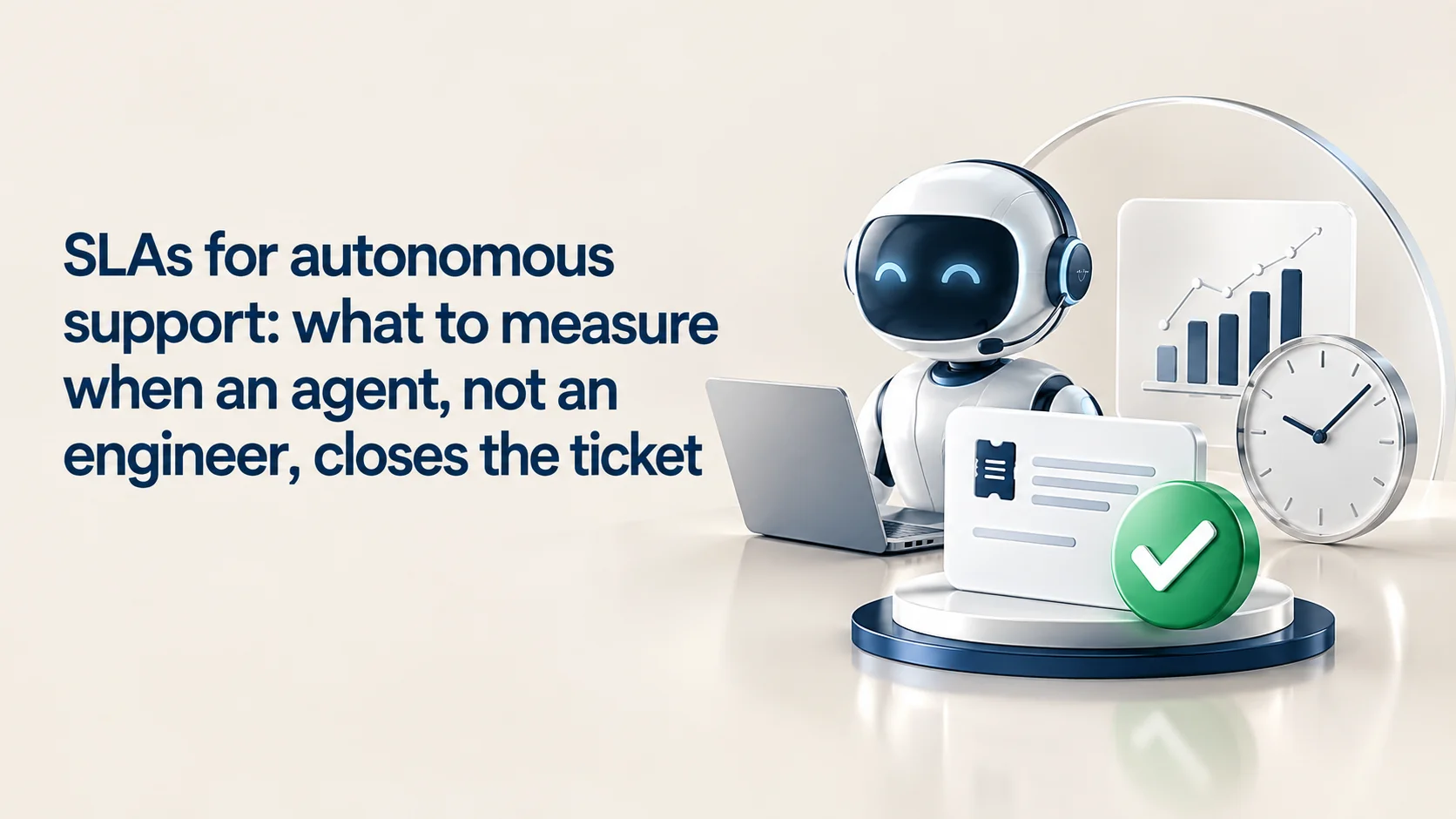
The AI just closed forty tickets before your coffee cooled and your SLA dashboard is green. That tells you almost nothing about whether the problems stayed fixed — and in an SAP landscape, the gap between “closed” and “solved” is where your next P1 is hiding.
Every AMS renewal season, the same three numbers get trotted out: first response time, ticket volume, mean time to resolution (MTTR). They were built for a world where a human engineer picked up every ticket, and they measured the thing that used to be scarce — attention. That scarcity is gone. When a Joule-style agent or an agentic AMS layer triages, diagnoses, and closes a ticket, first response time collapses to seconds by default and stops telling you anything useful. A metric every vendor can now hit trivially isn’t a metric; it’s a checkbox.
Traditional AMS SLAs measured activity as a proxy for quality
The uncomfortable truth is that the classic SLA numbers never measured quality directly — they measured activity as a proxy for it, because activity was the only thing hard to fake with a human workforce. An agent breaks that proxy completely. It can produce perfect-looking response-time and ticket-volume numbers while quietly making the underlying problem worse, and a response-time-based contract would never catch it.
Deflection is not resolution
This is the distinction that has to anchor any rewritten SLA: containment (no human touched the ticket) is not the same as verified resolution (the underlying problem is actually gone). A ticket can be “deflected” because the agent gave a confidently wrong answer and the user gave up, or because it closed without confirming the fix held — both count as wins on a containment dashboard. The gap is not small: independent industry research puts the difference between what AI touches and what it truly solves at 30 to 50 percentage points, and a 2025 survey found roughly two-thirds of CX leaders could not reliably distinguish their AI’s deflection rate from its actual resolution rate. Intercom’s own AI-agent unit, Fin, states the pattern plainly: a platform can show a 90% deflection rate and a 40% true resolution rate.
Where autonomous resolution actually stands
None of this means agents don’t work — the capability has genuinely matured. The share of support queries resolved without human intervention rose to about 65% in 2025, up from 52% in 2023, and well-implemented, action-taking agents — the ones wired into backend systems, not just a knowledge base — are landing first-contact resolution in the 70–90% range on the conversations they handle, versus a fraction of that for legacy deflection-only bots that can only recite policy. The capability gain is real. The measurement discipline hasn’t caught up with it.
The metrics that actually matter now
Once you accept that “was a human avoided” is the wrong question, three metrics become load-bearing for an agentic AMS SLA:
- Reopen rate — the share of agent-closed tickets that come back, tracked at both 48 hours and 30 days, because a fast false close is worse than a slow true one.
- Repeat-contact rate — whether the same underlying issue resurfaces under a different ticket description. This is endemic to SAP, where pricing mismatches, failed IDocs, and authorization errors recur under varied wording and get counted as separate “resolved” tickets.
- Escalation quality — whether an AI-to-human handoff arrives with the full diagnostic trail (logs, steps attempted, affected transactions) instead of a cold transfer that makes the engineer start from scratch.
Together these replace “how fast did it respond” and “how many tickets closed” with “did the fix hold, and did the handoff work when it didn’t.” A useful discipline from CX research: compute true resolution as deflected tickets minus wrong-or-incomplete answers minus short-window re-contacts, divided by total AI-handled volume — an auditable subtraction, not a self-reported closure count.
Why this is sharper in SAP AMS than in generic CX
Generic support can tolerate some slippage between deflection and resolution — the cost of a miss is a frustrated customer and a repeat email. In SAP AMS the cost structure is inverted. An agent that auto-closes a batch-job failure or an authorization ticket that then reopens as a P1 production incident has produced a worse outcome than a human engineer who took four extra hours to verify root cause before closing. Speed without verification isn’t efficiency in an ERP environment; it’s deferred risk, and it’s exactly the risk that response-time- and MTTR-based SLAs are structurally blind to.
| Traditional AMS SLA metric | Why it breaks with an autonomous agent | Agentic-AMS replacement |
|---|---|---|
| First response time | Near-instant by default; no longer differentiates providers | Verified resolution rate (confirmed fix, not just closure) |
| Ticket volume closed | Rewards activity and closure count, not outcome quality | 48-hour and 30-day reopen rate |
| MTTR | Measures speed to close, not durability of the close | Repeat-contact rate on the same root cause |
| SLA compliance (met/missed) | Silent on handoff quality when escalation happens | Escalation context-completeness score |
The contrarian position
Boards and CFOs are pushing AMS vendors toward AI because the cost delta is real — this isn’t hype, it’s economics. But the contract terms haven’t been rewritten to match the risk profile of an autonomous closer, only a self-reported closure count. The mismatch is where clients get burned. The fix isn’t to slow adoption of agentic AMS; it’s to stop measuring whether a human was avoided and start measuring whether the problem stayed solved. An SLA built around containment incentivises exactly the wrong behaviour — it pays the vendor for closing fast and says nothing about closing right.
Practitioner takeaway
Rewrite your next AMS statement of work around four clauses before you sign anything that includes agentic ticket closure:
- Verified-resolution clause — define resolution as a confirmed system-state change plus no reopen within a set window (30 days for functional issues, 7 for basis/infrastructure), not agent-reported closure.
- Reopen-as-severity-escalation clause — any ticket that reopens at a higher priority than it closed at triggers a penalty distinct from, and larger than, a standard SLA breach. This is the clause that prices in the “fast wrong fix beats slow right fix” risk.
- Escalation-context SLA$> require AI-to-human handoffs to carry the full diagnostic trail within a defined time, measured and reported separately from response time.
- Repeat-contact reporting — define resolution as a confirmed system-state change mondate monthly reporting of repeat-contact rate by root-cause category*, not just aggregate counts, so recurring SAP failures (pricing, IDocs, authorizations) surface instead of getting buried in volume.
The vendors who win the next generation of SAP AMS contracts will be the ones willing to be measured this way — because the ones who aren’t are the ones still selling you a response-time dashboard while the reopen rate quietly tells the real story.
### Sources – Notch — AI Customer Service Metrics that Matter in 2026 (deflection vs. resolution; leaders can’t distinguish the two): https://www.notch.cx/post/customer-service-ai-metrics – Fin (Intercom) — Resolution Rate vs Deflection Rate: https://fin.ai/learn/resolution-rate-vs-deflection-rate – Fini — How AI Support Platforms Measure Automation, Containment, Resolution Quality: https://www.usefini.com/guides/how-ai-support-platforms-measure-automation-containment-resolution-quality – Notch — AI Customer Support Resolution Rate Benchmarks 2026 (65% in 2025 vs 52% in 2023; 70–90% FCR): https://www.notch.cx/post/ai-customer-support-resolution-rate-benchmarks – Unthread — AI Support Productivity Benchmarks & SLA Insights 2026: https://unthread.io/blog/support-agent-productivity-statistics/ – Fin (Intercom) — AI Agent KPIs: Enterprise Performance Metrics Framework: https://fin.ai/learn/ai-agent-kpis-enterprise-performance-metrics-framework