The 2027 clock is real, the 2030 one is optional: reading the fine print on SAP’s deadline — and where agentic AI actually helps
What SAP has actually committed to
SAP Deadline Fine Print: 2027 & 2030
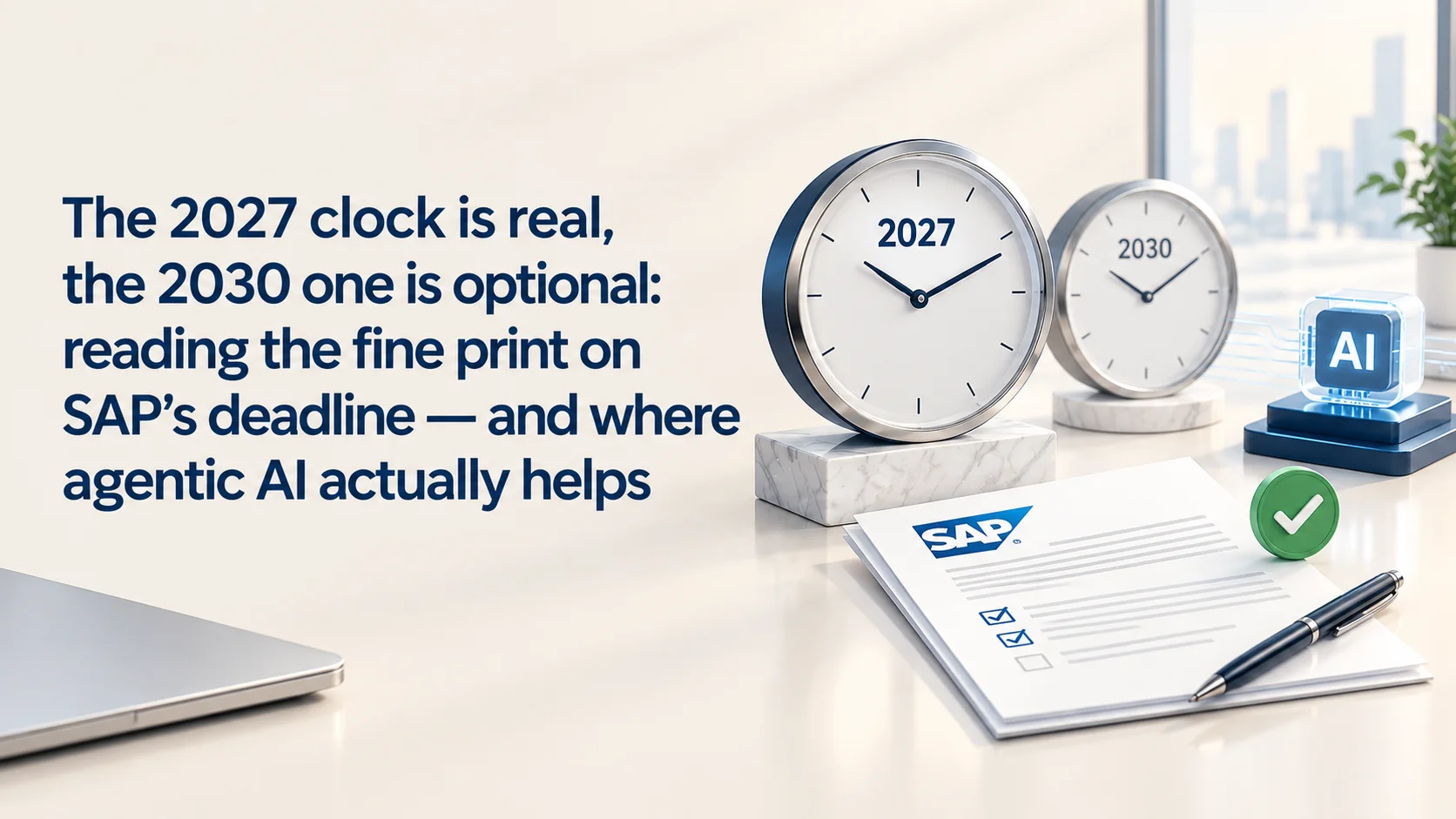
Strip away the noise and the commitment is precise. SAP provides mainstream maintenance for SAP Business Suite 7 core applications until the end of 2027. Beyond that, optional extended maintenance is available for three years, from the beginning of 2028 until the end of 2030 — at a premium of two percentage points on the maintenance basis, and only for the latest enhancement packages of SAP ERP 6.0. On the other side of the ledger, SAP has made an innovation commitment for SAP S/4HANA until the end of 2040: at least one S/4HANA release will always be in maintenance through 2040.
What SAP has actually committed to
So there are really two clocks. The 2027 one is real and unpaid. The 2030 one is optional, costs extra every year, and buys you no new capability — it is money spent on standing still.
What happens when your window closes
Once mainstream maintenance ends — or extended maintenance, if you buy it — Business Suite 7 systems move to customer-specific maintenance. In plain terms: no new fixes or patches beyond what already exists. The system keeps running, but every new legal change, security finding, or severe defect becomes your problem to solve, not SAP’s.
One trap worth checking this week: extended maintenance applies to the latest enhancement packages. If your estate sits on an older enhancement package, your effective window may already be shorter than the headline dates. Confirm your exact enhancement-package-level dates against SAP’s maintenance documentation for your specific release before anchoring a business case to 2027.
What a migration actually involves
SAP describes three transition paths to S/4HANA: System Conversion (brownfield — convert the system you have), New Implementation (greenfield — start clean), and Selective Data Transition (a hybrid — carry selected data and configuration forward). Whichever path you choose, the real work is the same unglamorous list: custom-code remediation, add-on and simplification-item checks, data cleanup, and testing.
This is where clean core changes the cost curve. SAP defines clean core as keeping the digital core standard and upgrade-stable while differentiating through side-by-side extensibility on SAP BTP or on-stack ABAP Cloud. Every modification you move out of the core is a modification that never again blocks an upgrade — or the next wave of AI capability.
Where agentic AI genuinely helps — and where it doesn’t yet
This is the part most marketing gets wrong, so let us be precise about what SAP has actually said.
- Joule agents are business-process automation, not a migration engine. SAP positions Joule agents as AI that works with business users to execute cross-functional processes — a Cash Collection Agent, for example. At SAP Connect in October 2025, SAP announced 14 new Joule Agents and a December 2025 general-availability date for Joule Studio; the announcement says nothing about ECC-to-S/4HANA migration. If someone pitches you “Joule will migrate your system,” that is a conflation.
- The migration-tooling claim is separate — and it is SAP’s own number. At SAP Sapphire in May 2026, SAP claimed its agent-led transformation tooling can “reduce ERP migration efforts by more than 35 percent” by automating analysis, code remediation, configuration, and testing. That is a vendor claim, not an independently validated outcome. Pressure-test it: ask which phases the figure covers, on what baseline, and what your system’s custom-code profile does to it.
- The prerequisite nobody markets: agents need a clean, standardized core and grounded data to work. The honest sequencing is that AI helps most once you are on — or moving to — a clean core. That makes the migration the enabler of the AI value, not the other way round.
A defensible 2026–2027 decision framework
Four questions settle most board conversations: Which enhancement package are we on, and what is our true maintenance date? Which of the three transition paths fits our custom-code and data reality? What moves out of the core to BTP, and what dies? And where, specifically, would AI-assisted tooling cut effort in our estate — with the vendor’s claims tested against our own code profile rather than taken on faith?
The deadline is a data-and-code problem first. Treat the AI as an accelerant on a well-planned move, not a substitute for one.
The 2027 clock is real and the 2030 one is rented. The organizations that come out ahead will be the ones that treat the migration as the enabler of the agentic era — a clean core first, then agents that actually have something solid to stand on.
Related reading
Sources
- support.sap.com — Maintenance strategy overview (SAP SE, official)
- support.sap.com — Maintenance strategy: SAP S/4HANA and Business Suite 7 (SAP SE, official)
- support.sap.com — Selective Data Transition engagement (SAP SE, official)
- news.sap.com — Extending SAP S/4HANA Cloud the right way: clean and clear (SAP News Center)
- news.sap.com — Joule: SAP uniquely delivers AI agents (SAP News Center)
- news.sap.com — SAP Connect: new Joule Agents and embedded intelligence (SAP News Center)
- news.sap.com — SAP Sapphire: SAP unveils the autonomous enterprise (SAP News Center)
Talk to us about this engagement.
Thirty minutes, one process, an honest read. No deck, no obligation.