
From vendor master to Business Partner: what actually changes in S/4HANA procure-to-pay
The honest headline: continuity above, rewiring below
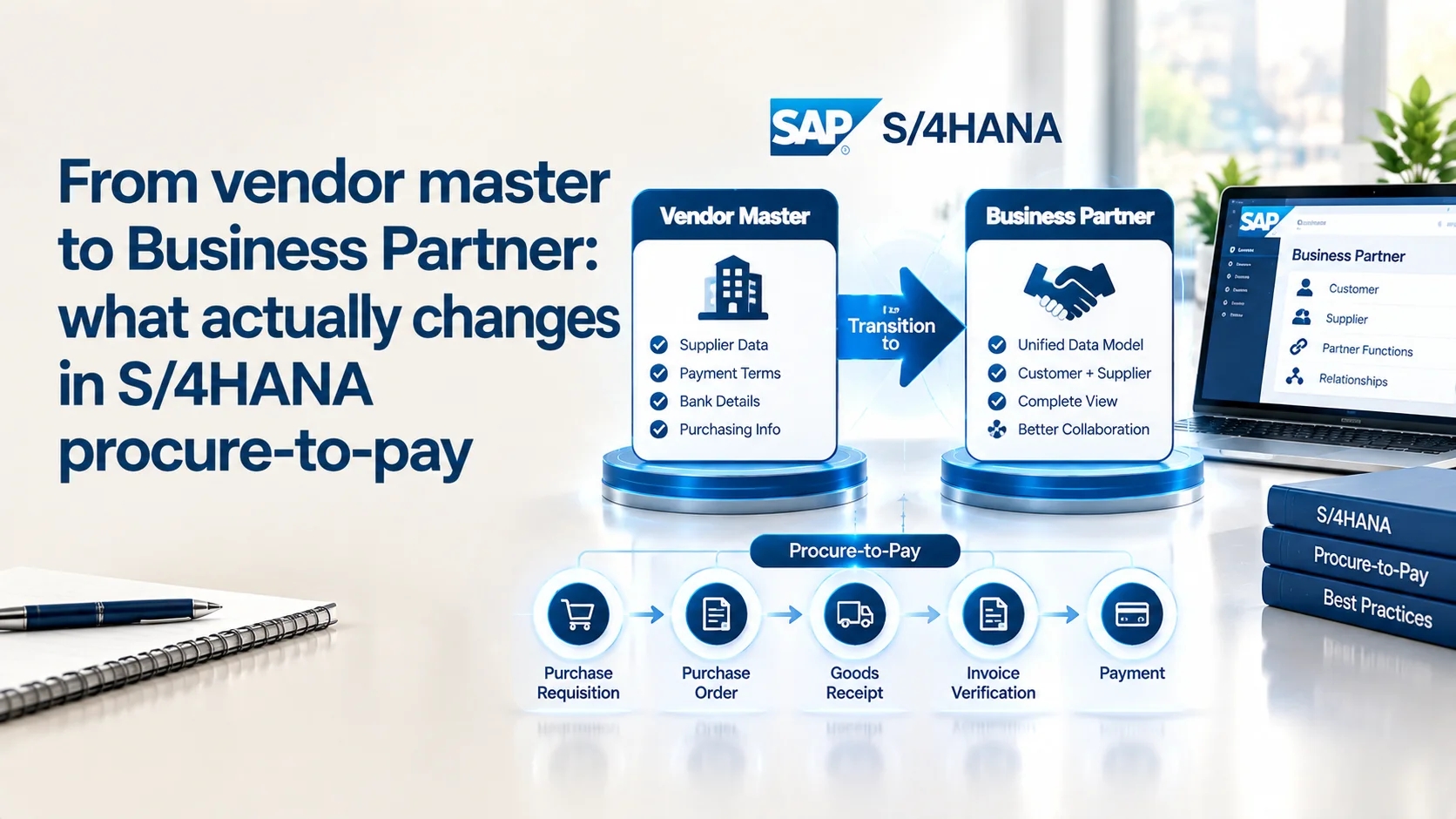
Procure-to-Pay: Vendor Master → Business Partner
The honest headline: continuity above, rewiring below
Procurement-transformation content usually sells outcomes — savings percentages, cycle-time cuts — and skips the structural mechanics. Let us do the opposite, because for the people who have to deliver this, the mechanics are the story. The day-to-day procure-to-pay process in S/4HANA is largely familiar to anyone who ran it in ECC. The foundation underneath — master data, table architecture, the buying front end, and the extensibility rules — is where the real change lives, and it is where P2P programs succeed or fail.
Supplier master, reimagined: Business Partner and the CVI gate
The single biggest structural change is master data. In S/4HANA, the Business Partner (BP) is the leading master-data object: the separate customer and vendor master maintenance of ECC — the KNA1 and LFA1 worlds — is replaced by one BP record carrying roles such as Supplier (FI) and Supplier (Purchasing).
For anyone converting from ECC, this is not a design option to weigh; SAP’s conversion guidance makes Customer/Vendor Integration (CVI) a mandatory prerequisite — all ECC customer and vendor master records must be converted to Business Partners before conversion, with CVI keeping BUT000 and the legacy tables synchronized. In plain terms: CVI is a gating item on your program plan, and the state of your vendor master data decides how painful that gate is. The familiar transaction codes go with it — the classic vendor-master transactions (XK01/XK02/XK03 and MK01/MK02/MK03) are superseded by BP maintenance, and attempts to use the old codes are redirected to the BP transaction.
The program implication is blunt: start CVI readiness — duplicate cleansing, field-mapping decisions, number-range strategy — long before anyone schedules a conversion weekend. It is the least glamorous workstream in the program and the one most often on the critical path.
The P2P spine you keep
Here is the continuity part, stated plainly because vendors rarely bother. The classic operational flow is retained in S/4HANA: purchase requisition — created manually or automatically via MRP, production, maintenance, or sales orders — to purchase order (ME21N), goods receipt (MIGO), and invoice verification (MIRO). Your buyers’ mental model survives; what changes around it is the Fiori experience and the real-time finance integration underneath.
The three-way match remains the control at the heart of it. SAP’s invoice-verification design compares the quantity and amount data of each supplier invoice item with the data of the related purchase order item and the goods receipt; the GR/IR clearing account nets to zero when goods receipt and invoice agree, and out-of-tolerance items are warned or blocked based on configured tolerance keys. One honesty note: tolerance percentages are customer-configured — there is no SAP default percentage, and any “touchless invoice rate” a vendor quotes you is their number, not a product property.
Under the hood: one table where twenty-six used to be
The most elegant change is invisible to users. S/4HANA’s simplified inventory data model collapses the classic MKPF/MSEG document tables into the single MATDOC table, dropping roughly 24 aggregate and history tables, with stock quantities calculated on the fly — the inventory counterpart to what the Universal Journal did for finance. The old table names persist as compatibility views, so most legacy reads keep working. What you gain is a single source of truth for material documents and genuinely real-time stock visibility; what you must check is any custom code that wrote to, or made timing assumptions about, the aggregate tables that no longer exist as tables.
The buying front door: guided buying and the Business Network
The requisition experience increasingly starts outside the ERP core. In SAP’s integrated design, employees create requests in SAP Ariba guided buying — catalog items, existing materials, lean services, limit or free-text items — and the request is replicated to S/4HANA, where a purchase requisition is created. The ERP stays the system of record; guided buying becomes the system of engagement.
Two naming updates matter for architects. Ariba Network is now SAP Business Network — which SAP positions as the world’s largest B2B trading-partner platform, supporting more than US$6.5 trillion in annual transactions across millions of companies in 190 countries — and the integration to S/4HANA runs through SAP Integration Suite, Managed Gateway for Spend Management and SAP Business Network, the successor to the Ariba Cloud Integration Gateway. If your integration architecture documents still say “CIG,” they are describing the previous decade.
Clean core: the make-or-break nobody budgets for
Every seasoned MM team carries a list of things “we always customized in ECC.” That reflex is the trap. S/4HANA’s extensibility rules are explicit: do not modify SAP objects; extend on-stack with ABAP Cloud through released APIs, released BAdIs, and RAP business-object extension points, or side-by-side on SAP BTP for anything that can live decoupled from the core. Only released public SAP APIs and extension points are sanctioned paths.
This is a program-governance matter, not a developer preference: every P2P customization request should pass through a standardization decision — standard first, released extension point second, BTP third, modification never. The organizations that hold that line keep their upgrade path; the ones that do not rebuild this debt on a newer platform.
The before/after, consolidated
What genuinely changes versus ECC: the supplier master object (vendor master → Business Partner, with CVI as a mandatory conversion gate), the inventory table architecture (MKPF/MSEG → MATDOC), the buying front end (guided buying and SAP Business Network via Integration Suite), the extensibility rules (released APIs and BTP, not modifications), and the analytics that real-time data models make possible. What largely does not change: the P2P spine itself — requisition, order, receipt, invoice, three-way match. Plan the program around the first list; reassure the business with the second.
The P2P flow is continuity; the foundation is revolution. Treat Business Partner/CVI and clean-core extensibility as the two load-bearing changes — budget them first — and the rest of the transformation stands on something solid.
Sources
Talk to us about this engagement.
Thirty minutes, one process, an honest read. No deck, no obligation.