
One SAP platform, three VAT regimes: the KSA–UAE–Bahrain differences that derail regional rollouts
The mirage of “GCC VAT”
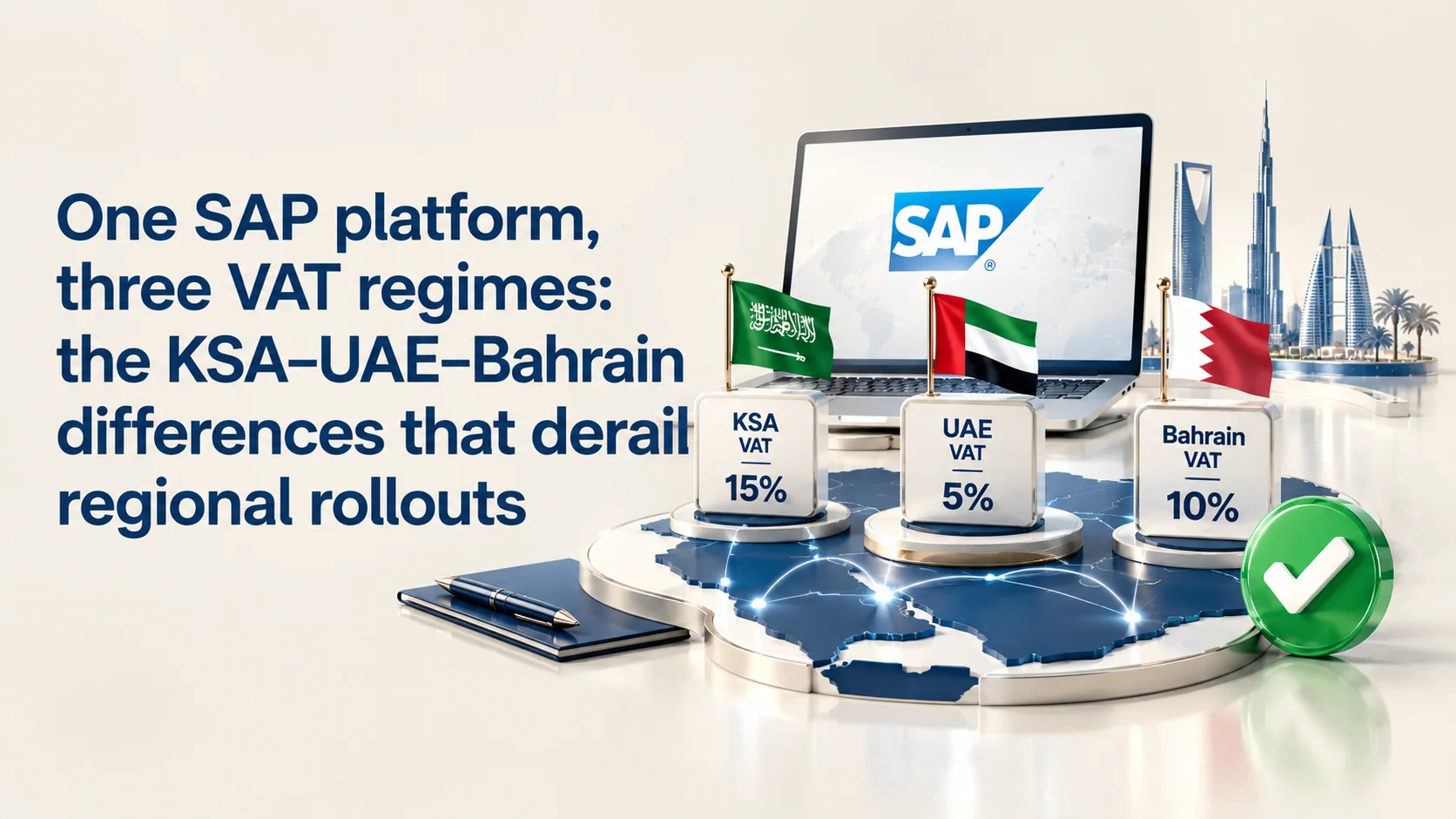
GCC VAT: KSA vs UAE vs Bahrain
| Dimension | KSA (ZATCA) | UAE / Bahrain |
|---|---|---|
| VAT Rate | 15% | UAE 5% / Bahrain 10% |
| E-invoicing | ZATCA Phase 2 — mandatory | UAE mandate incoming / Bahrain API |
| SAP Config | DRC + ZATCA API | UAE: PINT AE / BH: API |
| Filing | Real-time clearance model | Periodic VAT return |
| Compliance AI | ZATCA AI agents active | Emerging mandate landscape |
The mirage of “GCC VAT”
Regional SAP rollouts love a common template, and finance leadership loves the phrase “GCC VAT” — it suggests one regime, one configuration, one compliance process rolled out three times. The reality is three national regimes that have diverged in rate, in filing model, and — most consequentially — in how the tax authority touches the invoice itself. Templates that ignore this converge on the same failure mode: the first country goes live cleanly, and the second country’s localization becomes an unplanned project.
The rates and dates, precisely
- UAE: VAT was introduced across the UAE on 1 January 2018 at a standard rate of 5%, where it remains.
- Saudi Arabia: the standard rate increased from 5% to 15% effective 1 July 2020 (as reported by Deloitte, and confirmed by PwC’s tax summaries).
- Bahrain: the standard rate doubled from 5% to 10% with effect from 1 January 2022; the official Bahrain national portal confirms 10% applied from that date.
Three rates, three effective-date histories — and two of the three rates have already changed once since introduction. A template that hard-wires rates instead of treating them as dated configuration has already failed the next rate change.
The deeper divergence: how the authority touches your invoices
Rates are the visible difference; the filing and clearance models are the structural one.
Saudi Arabia runs mandatory e-invoicing under ZATCA’s FATOORAH program, in two phases: Phase 1 (Generation) from 4 December 2021, requiring invoices to be generated and stored through compliant electronic solutions, and Phase 2 (Integration) from 1 January 2023, rolled out in waves and requiring integration of those solutions with ZATCA’s systems. In KSA, the regulator sits inside the invoicing flow.
The UAE, by contrast, operates on periodic returns: VAT returns are submitted quarterly or monthly depending on the allocation by the Federal Tax Authority. Bahrain likewise operates on periodic returns through the National Bureau for Revenue; we deliberately do not state the monthly-versus-quarterly thresholds and deadlines here, as they should be confirmed against the NBR’s own filing manual.
Two caveats to keep this contrast honest. First, it describes the sourced position at the time of writing: the UAE has been moving towards an e-invoicing program of its own, so do not architect on the assumption that periodic returns are the UAE’s permanent end-state — that would be a projection, and rollout designs should track FTA announcements. Second, “periodic returns” does not mean “simple”: return formats and e-filing mechanics differ per country and change on the regulator’s schedule, not yours.
What this means inside SAP
The following describes standard SAP configuration practice for multi-country VAT — design guidance, not SAP-documented product claims; where SAP’s own documentation is the source, we say so.
The rollout traps, named
Three recurring patterns explain most regional VAT rework (our read of the failure mode, not a statistic): treating the first live country’s configuration as “the template” and forcing later countries into its assumptions; scheduling localization late, after integration testing, where e-invoicing requirements surface as blockers; and leaving tax-rate and return-format changes to be discovered by the business rather than monitored as regulatory watch items. All three are sequencing and ownership decisions — which means all three are avoidable at design time.
“GCC VAT” is a useful phrase for a steering committee and a dangerous one for a design authority. Build one governance model and three country-complete configurations — because the regulators are three, and each of them changes the rules on their own clock.
Sources
| # | URL | Publisher |
|---|---|---|
| 1 | https://mof.gov.ae/en/public-finance/tax/value-added-tax-vat/ | UAE Ministry of Finance (official) |
| 2 | https://taxsummaries.pwc.com/united-arab-emirates/corporate/other-taxes | PwC (Tier-B) |
| 3 | https://www.bahrain.bh/wps/portal/en/BNP/HomeNationalPortal/ContentDetailsPage/ | Bahrain national portal (official) |
| 4 | https://www.deloitte.com/middle-east/en/services/tax/perspectives/vat-rate-increase.html | Deloitte ME (Tier-B) |
| 5 | https://www.deloitte.com/middle-east/en/services/tax/perspectives/ksa-vat-rate-increase-15percent-1-july-2020.html | Deloitte ME (Tier-B) |
| 6 | https://taxsummaries.pwc.com/saudi-arabia/corporate/other-taxes | PwC (Tier-B) |
| 7 | https://taxsummaries.pwc.com/bahrain/corporate/other-taxes | PwC (Tier-B) |
| 8 | https://zatca.gov.sa/en/E-Invoicing/Introduction/Pages/Roll-out-phases.aspx | ZATCA (official) |
| 9 | https://help.sap.com — Supported Compliance Tasks by Country/Region; VAT Return – Saudi Arabia; Tax Invoicing in KSA (SAP Business Network) | SAP (official) |
Talk to us about this engagement.
Thirty minutes, one process, an honest read. No deck, no obligation.