
A 2025 industry survey reported by CFO.com found that half of finance teams take longer than five business days to close: only 18% close in one to three days, 32% take four to five, 23% take six to seven, and 27% take more than seven. The underlying survey (Ledge, 100 finance professionals — a vendor survey, read it as directional) adds that 94% of teams still rely on spreadsheets in the close, cross-department dependency is the top blocker at 56%, and cash reconciliation alone consumes 20–50 hours a month across three to five systems.
Into that pain, vendors are shipping finance agents into production this year. SAP describes its financial-close assistant as designed to “surface bottlenecks, automate postings and reconciliations, and resolve discrepancies in real time with accuracy and auditability”, and positions its autonomous close capability to “compress the financial close process from weeks to days” — a vendor claim, not an independent measurement. So the CFO’s real question is not “is this coming?” It is: what can such an agent actually, safely do?
01The one boundary that matters
Here is the uncomfortable empirical fact. An independent benchmark of five leading LLMs (the ORCA benchmark, November 2025) found they got real-world calculation tasks right only 45–63% of the time, with errors dominated by rounding (35%) and calculation mistakes. These are the most capable models on the market — and they are not reliable calculators.
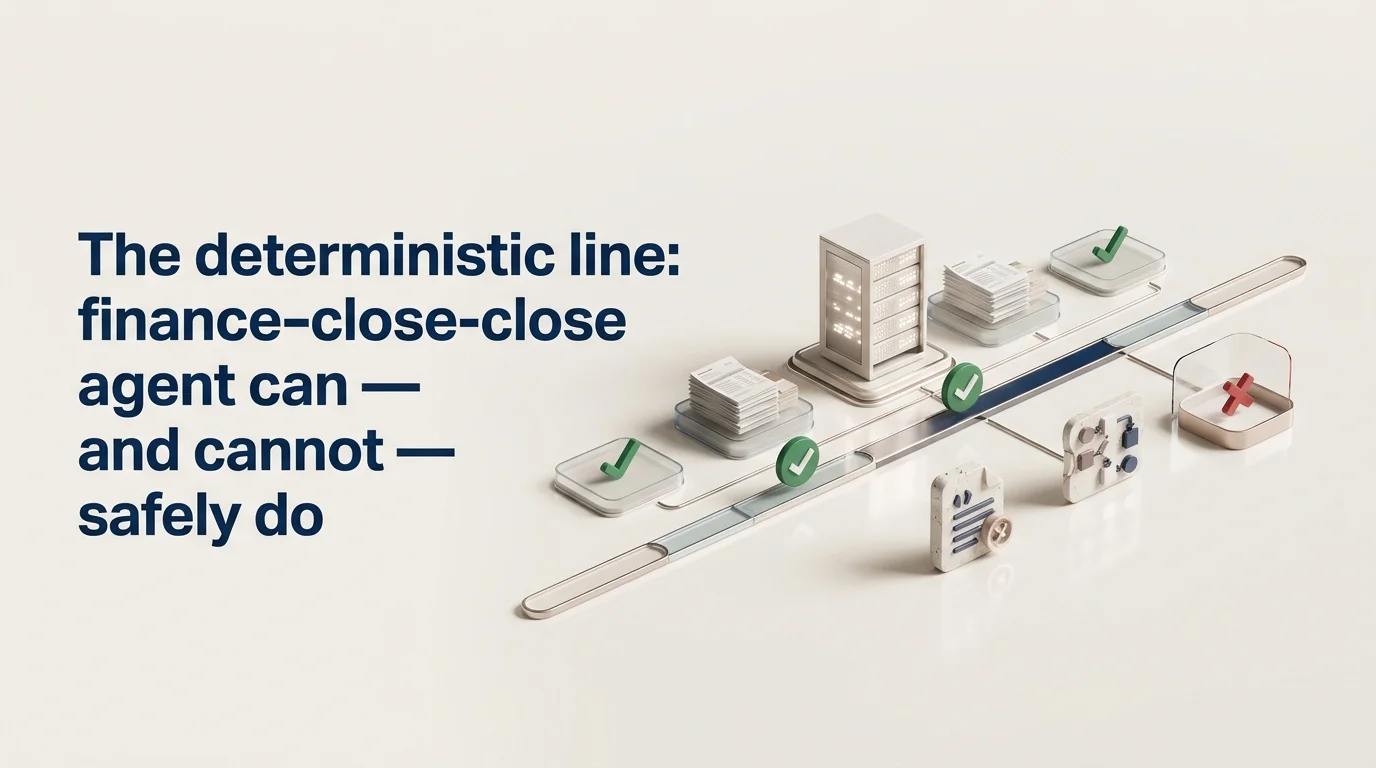
The conclusion is not “agents are unsafe.” It is architectural: the numbers cannot live in the model. The LLM’s job is to interpret intent, route work, draft narratives and journal-entry proposals, and explain exceptions. The actual postings, tax calculations, and compliance validations must execute in deterministic, tested, versioned code — the same class of software your auditors already understand. That boundary — the deterministic line — is what separates a trustworthy close agent from a liability with a chat interface.
Where the boundary sits
02What a finance-close agent can safely do
On the right side of the line, the agent earns real hours back: gathering and reconciling data across the three-to-five systems that eat 20–50 hours a month; flagging exceptions and variances with an explanation of why they look wrong; drafting journal-entry proposals and close narratives for a human to review; chasing the cross-department dependencies that 56% of teams name as their top blocker; and surfacing bottlenecks in the close calendar in real time.
03What it must not do unsupervised
And on the wrong side: it must not invent or compute the numbers (that is what the 45–63% figure is telling you); it must not post to the ledger without human approval; it must not submit a tax filing or e-invoice autonomously; and it must never act without leaving an audit trail. None of these are temporary limitations to be engineered away later. They are the design.
Can safely do
Gather and reconcile data across systems, flag exceptions and variances with explanations, draft journal-entry proposals and close narratives, chase cross-department dependencies, and surface close-calendar bottlenecks in real time.
Must not do unsupervised
04Four engineering guardrails — our stance
These are IOTEK’s engineering principles for finance agents — stated as our position, not statistics:
- Deterministic core. The LLM orchestrates, drafts, and explains; numbers, tax logic, and compliance validations run in deterministic, versioned code — never generated free-hand. (Externally grounded by the ORCA results.)
- Human-in-the-loop approval. Postings, adjustments, and compliance submissions require explicit human approval. The agent presents evidence and a recommendation; it does not commit financially consequential actions on its own.
- Idempotency — no duplicate postings. Every posting and submission carries an idempotency key, so retries, agent loops, or network faults can never create a duplicate journal entry or e-invoice. As the IEEE Computer Society puts it, idempotency ensures “no matter how many times a request is made, the outcome remains unchanged after the first one.”
- Audit trail by construction. Every agent action — inputs, tool calls, deterministic result, approving human — is logged, so the close and the filings stay explainable to auditors and tax authorities.
Deterministic core. The LLM orchestrates, drafts, and explains; numbers, tax logic, and compliance validations run in deterministic, versioned code — never generated free-hand. (Externally grounded by the ORCA results.)
Human-in-the-loop approval. Postings, adjustments, and compliance submissions require explicit human approval. The agent presents evidence and a recommendation; it does not commit financially consequential actions on its own.
Audit trail by construction. Every agent action — inputs, tool calls, deterministic result, approving human — is logged, so the close and the filings stay explainable to auditors and tax authorities.
05Compliance raises the stakes: ZATCA and ViDA
This is not only about internal quality. E-invoicing compliance is becoming legally mandatory and real-time in both regions we serve.
Two regimes, one requirement: deterministic validation
This is not only about internal quality. E-invoicing compliance is becoming legally mandatory and real-time in both regions we serve. Saudi Arabia’s ZATCA Phase 2 “Integration Phase” (from January 2023, in waves, with at least six months’ notice per wave) requires integrating e-invoicing solutions directly with ZATCA’s systems. In Europe, the VAT in the Digital Age (ViDA) package was adopted on 11 March 2025; Member States can mandate e-invoicing from entry into force, and cross-border digital reporting requirements apply from 1 July 2030. When the tax authority validates your documents in real time, “the model was 95% sure” is not a defense. Deterministic validation is non-negotiable.
06The honest ROI story
Measured against the survey data, the honest targets are concrete: hours back on reconciliation (that 20–50 hours a month), faster exception handling, and cycle days recovered — framed as outcomes to measure in your close, not guaranteed multipliers. SAP’s “weeks to days” is SAP’s own positioning; Constellation Research’s Holger Mueller calls finance “a home game for SAP” while cautioning that the value proposition is unproven pending execution — a sober outside view we share. Pilot, measure, and let your own close calendar tell you the ROI.
Agents don’t get to invent numbers. The LLM orchestrates, drafts, and explains; deterministic code calculates; a human approves. That line is not a limitation to apologise for — it is the design choice that makes a finance agent worth trusting with your close.
References
cfo.com — 50% of finance take a week to close the books (CFO.com / Industry Dive, reporting the Ledge 2025 survey)
ledge.co — Month-end close benchmarks for 2025 (Ledge, primary survey, n=100, vendor-authored)
arxiv.org — ORCA benchmark (November 2025) (arXiv preprint)
cfodive.com — SAP ramps push toward autonomous finance with agentic AI (CFO Dive)
news.sap.com — SAP Sapphire: SAP unveils the autonomous enterprise (SAP News Center)
constellationr.com — SAP Sapphire 2026: SAP makes its case (Constellation Research, Holger Mueller)
zatca.gov.sa — E-invoicing roll-out phases (ZATCA, official)
taxation-customs.ec.europa.eu — VAT in the Digital Age (ViDA) (European Commission, official)
computer.org — Idempotency in payment processing architecture (IEEE Computer Society)
Sources
- cfo.com — 50% of finance take a week to close the books (CFO.com / Industry Dive, reporting the Ledge 2025 survey)
- ledge.co — Month-end close benchmarks for 2025 (Ledge, primary survey, n=100, vendor-authored)
- arxiv.org — ORCA benchmark (November 2025) (arXiv preprint)
- cfodive.com — SAP ramps push toward autonomous finance with agentic AI (CFO Dive)
- news.sap.com — SAP Sapphire: SAP unveils the autonomous enterprise (SAP News Center)
- constellationr.com — SAP Sapphire 2026: SAP makes its case (Constellation Research, Holger Mueller)
- zatca.gov.sa — E-invoicing roll-out phases (ZATCA, official)
- taxation-customs.ec.europa.eu — VAT in the Digital Age (ViDA) (European Commission, official)
- computer.org — Idempotency in payment processing architecture (IEEE Computer Society)
Bring us your close calendar.
Thirty minutes, one process, an honest read on where a deterministic-core agent would actually save you hours — and where it shouldn’t touch a thing.